
Who this is for, and what makes contracting different
This is for general contractors, remodelers, roofers, electricians, plumbers, landscapers and specialty trades working in Orange County. Everything here you can do yourself.
Three things make contracting unlike most local trades:
- The ticket is large and the decision is slow. Nobody picks a $40,000 remodeller in an afternoon. They look, shortlist, check reviews, look again, and call three. Your job is to survive the shortlist, and that is decided by proof rather than persuasion.
- Your work is visual, and that is an advantage most trades do not have. A finished kitchen is both a sales tool and content Google can read. Very few local businesses get that for free.
- Licensing is a trust signal you are legally required to have anyway. Displaying your CSLB number is not marketing, it is proof — and homeowners in Orange County do check.
Each section below is short and links to the detailed article where one exists. This page is the map.
Are homeowners finding you? Four checks
Incognito window, or your own history will flatter you.
-
Search your trade plus your city
"General contractor Huntington Beach", "kitchen remodel Costa Mesa". Are you in the map pack — the three businesses with the map beside them?
-
Search the job, not the trade
"Kitchen remodel Orange County", "bathroom renovation Newport Beach", "room addition Fountain Valley". These are the searches by people who already know what they want built, and they convert far better than the generic trade search.
-
Search "licensed contractor" plus your city
Homeowners burned once search this way deliberately. If your licence number is not visible on your site and profile, you are invisible to the most cautious buyers — who are often the ones with the biggest budgets.
-
Open your site on your phone
Over 60% of contractor searches happen on mobile. On cell data, count the seconds until you can see a project photo and tap a phone number.
The full five-test version covers the general checks.
Google Business Profile: service area, not storefront
Most contractors set their profile up as if they were a shop. They are not, and the setup is different.
Hide your address and set a service area. You go to the customer; they do not come to you. Google has a specific setting for this. Listing a home address as a storefront looks wrong to Google and to homeowners.
Pick the most specific primary category. The same rule that governs every trade, and the one most contractors get wrong:
| If you mainly do | Primary category | Not |
|---|---|---|
| Roofing | Roofing Contractor | General Contractor |
| Kitchen work | Kitchen Remodeler | General Contractor |
| Bathrooms | Bathroom Remodeler | Contractor |
| Genuinely everything | General Contractor | Construction Company |
Then add the others as secondary categories. A remodeller who only lists General Contractor is invisible for "kitchen remodeler near me".
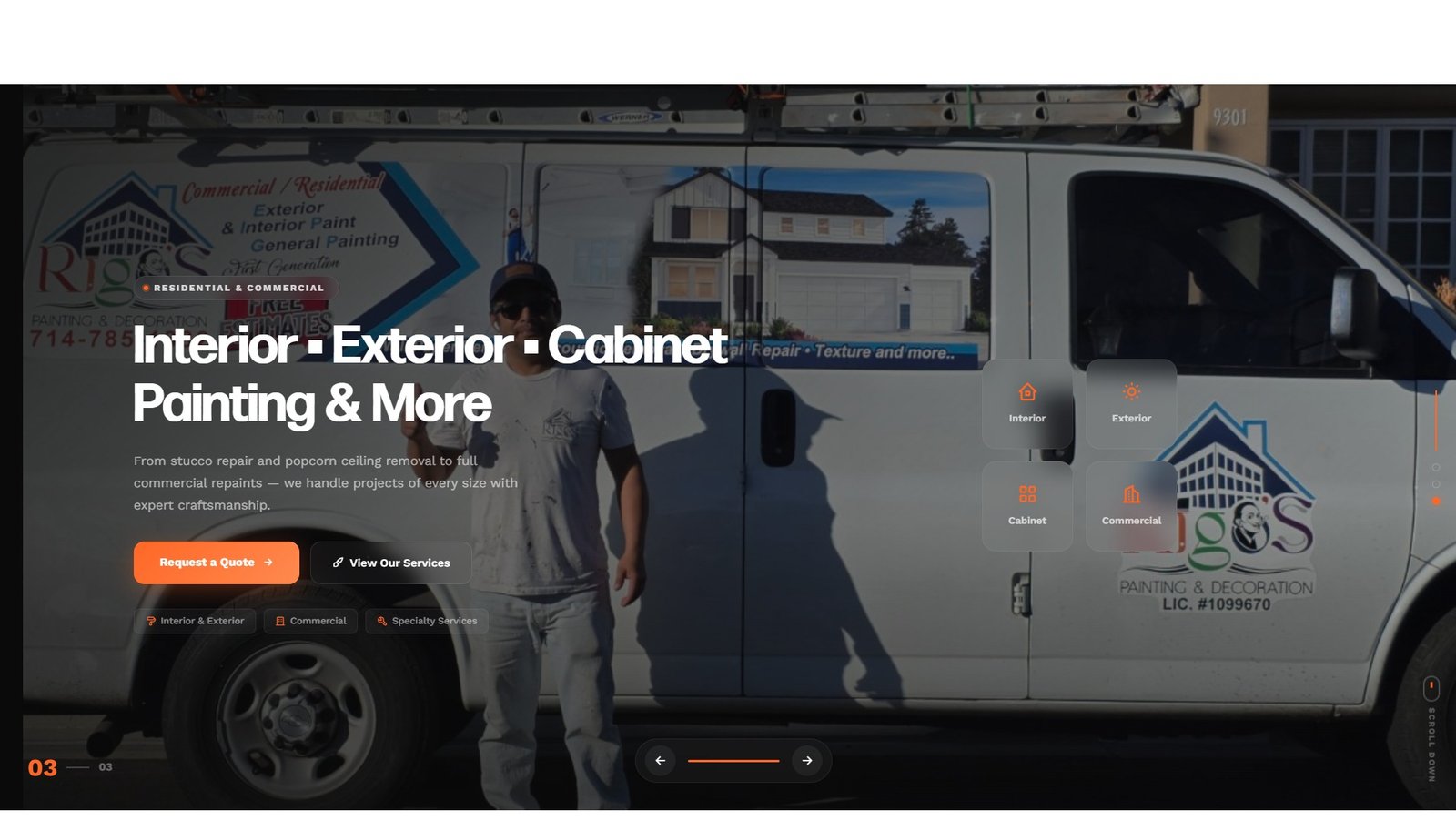
Photos are not decoration for your trade — they are the product. Upload finished projects regularly, and shoot the same job before and after. Rigos Painting features over 10,000 completed projects, and that volume of visible work is itself the argument.
Seed the Q&A: are you licensed and insured in California, are estimates free, and which cities do you cover. Those are the three every homeowner wants answered before calling.
The full chapter has claiming, verification and posts.
Reviews: the permission slip for a high-ticket job
For a trade where the average job runs into thousands, reviews are not a nice-to-have. A homeowner is not spending $30,000 with a contractor who has three reviews and a 3.8-star rating, however good the work is.
The benchmarks:
- 50 or more reviews earns roughly 4.4 times more clicks than under five.
- 68% of consumers require a 4-star minimum.
- Around 150 reviews is where AI assistants begin naming a business.
What is achievable, from real Orange County contractors: Rigos Painting holds a 5.0 rating with over 1,000 reviews. Yanis Remodeling maintains 5.0 across 27+ verified reviews — proof that a smaller, newer business can hold the rating even without the volume.
The contractor-specific part: ask at final walkthrough, when the homeowner is standing in the finished room. That is the peak of the whole relationship and it never comes back. Waiting until the invoice clears loses most of it.
Steady beats sudden. Forty reviews earned over a year beats sixty in one week, because a burst looks bought.
The full reviews chapter has the scripts and the reply templates.
Your website: the portfolio is the site
For most local businesses the website supports the profile. For a contractor it does more, because the buying decision needs evidence that a listing cannot hold.
Four things a contractor site must have:
- A real project portfolio, with real photographs. Not stock. Named projects with a location and a short description. This does double duty: it convinces the homeowner and it gives Google image-rich content to index. JVB Construction publishes named projects — Open-Concept Conversion, Marc Bach Penthouse, Huntington Harbour — rather than a generic gallery.
- Your licence number and insurance, visible. JVB displays CSLB #808208; Rigos displays #1099670. It costs nothing and it removes the single biggest objection.
- A page for each service and each city. One page listing twelve cities ranks for none of them. JVB runs 14 dedicated service pages across 13 Orange County cities.
- Some indication of price. Uncomfortable, but it filters. JVB publishes tiers — $15K–$25K, $25K–$55K, $55K–$100K+ — and the effect is fewer unqualified calls, not fewer good ones.
Photograph every job. Same angle, before and after, on a phone, takes two minutes. That habit is worth more over a year than any single marketing decision you will make.
Contractor website design in Huntington Beach covers what actually wins local leads. The general chapter covers speed and Core Web Vitals.
Seasonality: when Orange County homeowners actually buy
Contracting demand is not flat, and the calendar here is not the national one. Southern California has its own pattern:
| Season | What sells |
|---|---|
| Spring | Kitchen and bathroom remodels peak |
| Early summer | Outdoor living, decks, hardscape surge |
| Winter rains | Emergency repair spikes — roofing, water damage, drainage |
| Autumn | Planning season for spring projects |
The practical consequence: content and pages need to be live four to six weeks before the demand, not during it. A kitchen remodel page published in April has missed the spring decision window. Publish it in February.
The same applies to your profile posts. Post about outdoor projects in May, not July.
AI search and social: the honest verdicts
AI search: worth doing, and almost nobody in your trade has. The prompts homeowners use are specific — "who's a good kitchen remodeler in Huntington Beach", "licensed contractor near Costa Mesa for a room addition". If your site answers those in plain sentences that name the business, the city and the fact, an assistant can lift the answer. The AI search chapter has the method.
Social media: some. Before-and-afters do genuine work for a visual trade, and they cost you nothing beyond the two minutes you already spent photographing the job. But the buying decision starts in search, not in a feed. Nobody browses Instagram looking for a contractor — they browse it after they have found you, to check you are real.
So: post the work, keep the account alive, and do not let anyone sell you a social retainer as a substitute for search. The general chapter has the per-trade comparison.
Your first 90 days, sequenced for a contractor
Free, and do it yourself
- Claim your Google Business Profile, hide the address, set the service area.
- Set the most specific primary category, add the rest as secondary.
- Upload twenty photographs of finished work.
- Add your licence number everywhere it can go.
- Ask your last ten customers for a review, by text, with the direct link.
Why first: profile signals are roughly 32% of local ranking weight and reviews another 16%. Both free.
Fix the site
- Test it on your phone on cell data. Fix whatever fails.
- Tappable phone number above the fold on every page.
- Build or rebuild the portfolio page with real project photographs.
- Start the habit: photograph every job, same angle, before and after.
Build
- One page per service you want to be found for.
- One page per city, each with genuinely local content — not the same paragraph with the name swapped.
- Push past 50 reviews.
- Add LocalBusiness schema and check AI crawlers are not blocked.
Measure, and plan the season
- Re-run the four checks and compare against your first attempt.
- Count estimate requests, not rankings.
- Look four to six weeks ahead and publish for the next season now.
What to expect. Traffic in 30 to 60 days, map pack in 60 to 90, steady lead flow by month three. Yanis Remodeling went from two or three consultation requests a month to roughly four times that within a quarter of launching.
What it costs, and how to judge a quote
Pricing is not trade-specific, so this page does not repeat it. What to know before you talk to anyone:
- The average agency retainer across the industry is about $3,209 a month. Local SEO for a small contractor typically runs $500 to $1,500 for a narrow scope.
- Below roughly $500 a month, do the free work yourself first.
The marketing cost calculator works out your number from four questions. The chapter on hiring an agency has the five questions worth asking, and they apply to us too.
Orrku Media builds websites and local SEO for contractors in Huntington Beach, CA, and Rigos Painting reached page one across multiple Orange County cities with a 5.0 rating and over 1,000 Google reviews.
Serving Huntington Beach, Costa Mesa, Newport Beach and surrounding areas. Local SEO in Huntington Beach, CA · Talk to Ram